No Lesson Learnt: Coinbase and the Crypto Hire-Fire Cycle
Coinbase fired 700 people during its 12th profitable quarter.
TL;DR
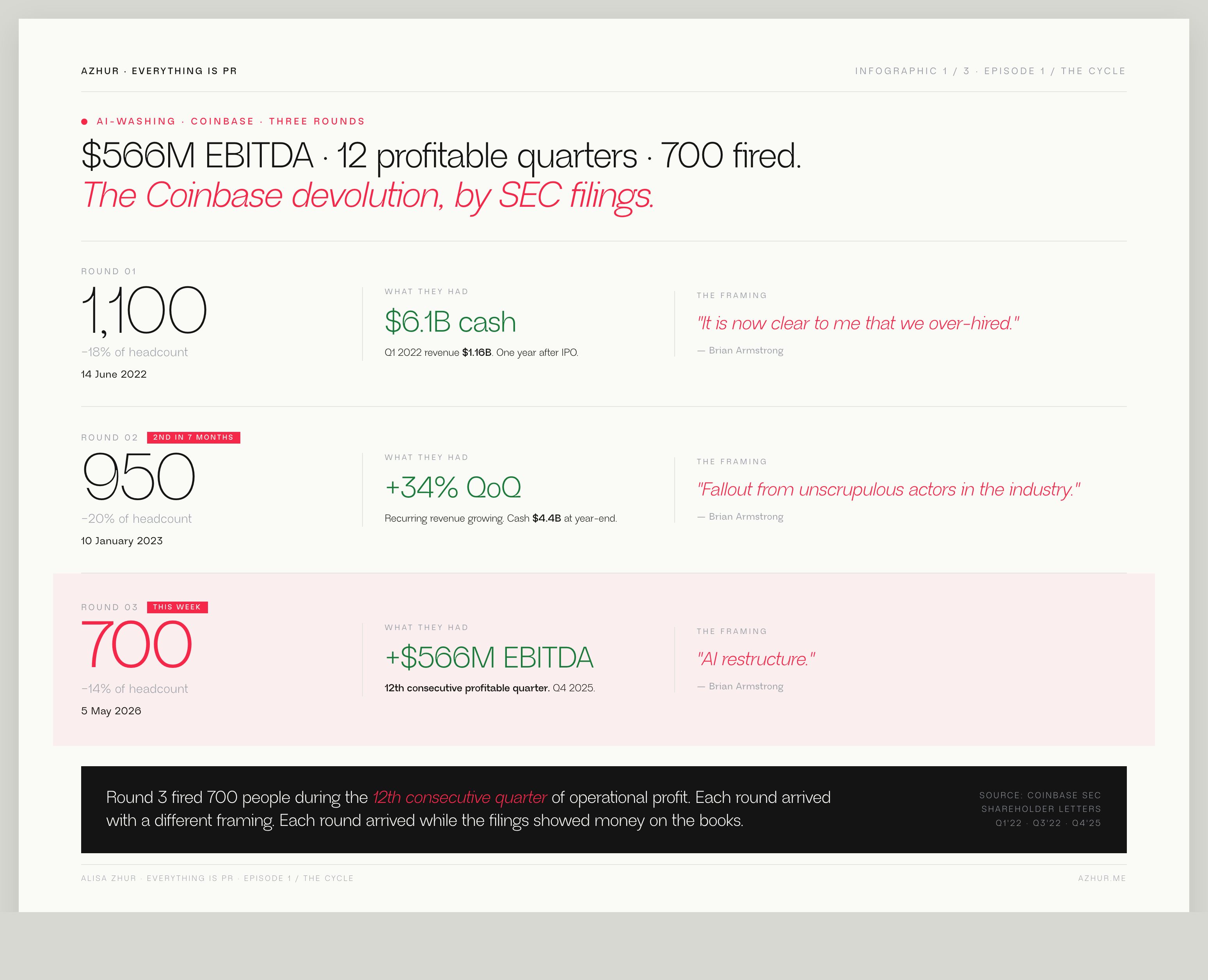
On Tuesday, 5 May 2026, Coinbase fired 700 people in a single morning. Two days later, the company reported its 12 consecutive quarter of operational profitability — $566 million in adjusted EBITDA, a 31.8% margin in a down quarter for crypto.
This is the third Coinbase layoff round in under four years. Each one arrived with a different label. The SEC filings attached to each one disagree.
VISUAL #1. Coinbase three rounds vs profitability.
Three rounds. Three filings. Three excuses.
Round 1 — June 2022. "We over-hired." The Q1 2022 filing showed a $430M GAAP loss — but adjusted EBITDA was still positive at +$20M, the company held $6.1B in cash, and had raised $2B in senior notes nine months earlier in an offering oversubscribed by $7B. The diagnosis was true on the income statement; the decision to cut 1,100 people rather than absorb the loss was discretionary.
Round 2 — January 2023 (the second round in seven months). "Unscrupulous actors." The pre-layoff disclosure showed a $576M loss but recurring revenue up 34% quarter-over-quarter, with $4.4B in cash.
Round 3 — May 2026. "AI restructure." Pre-layoff: $566M of adjusted EBITDA. Twelfth consecutive profitable quarter.
This is a playbook, not a crisis. The pattern is bigger than Coinbase.
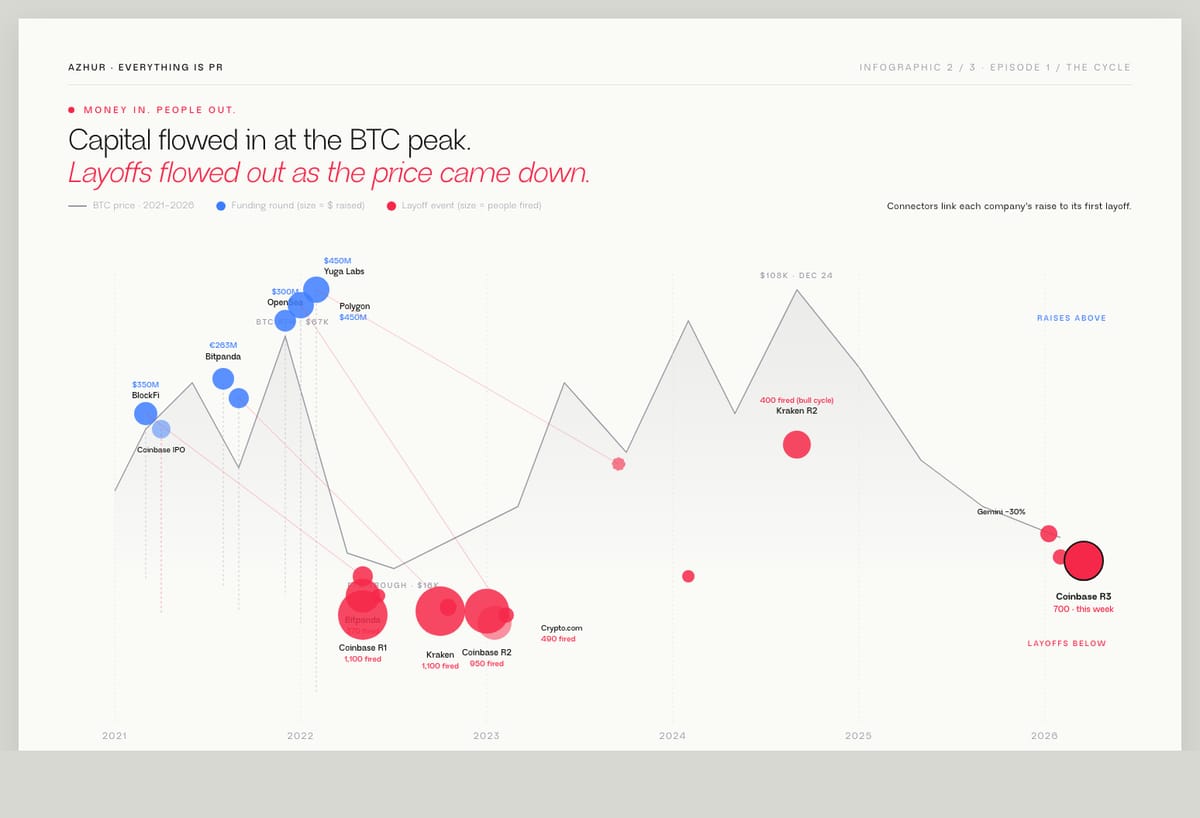
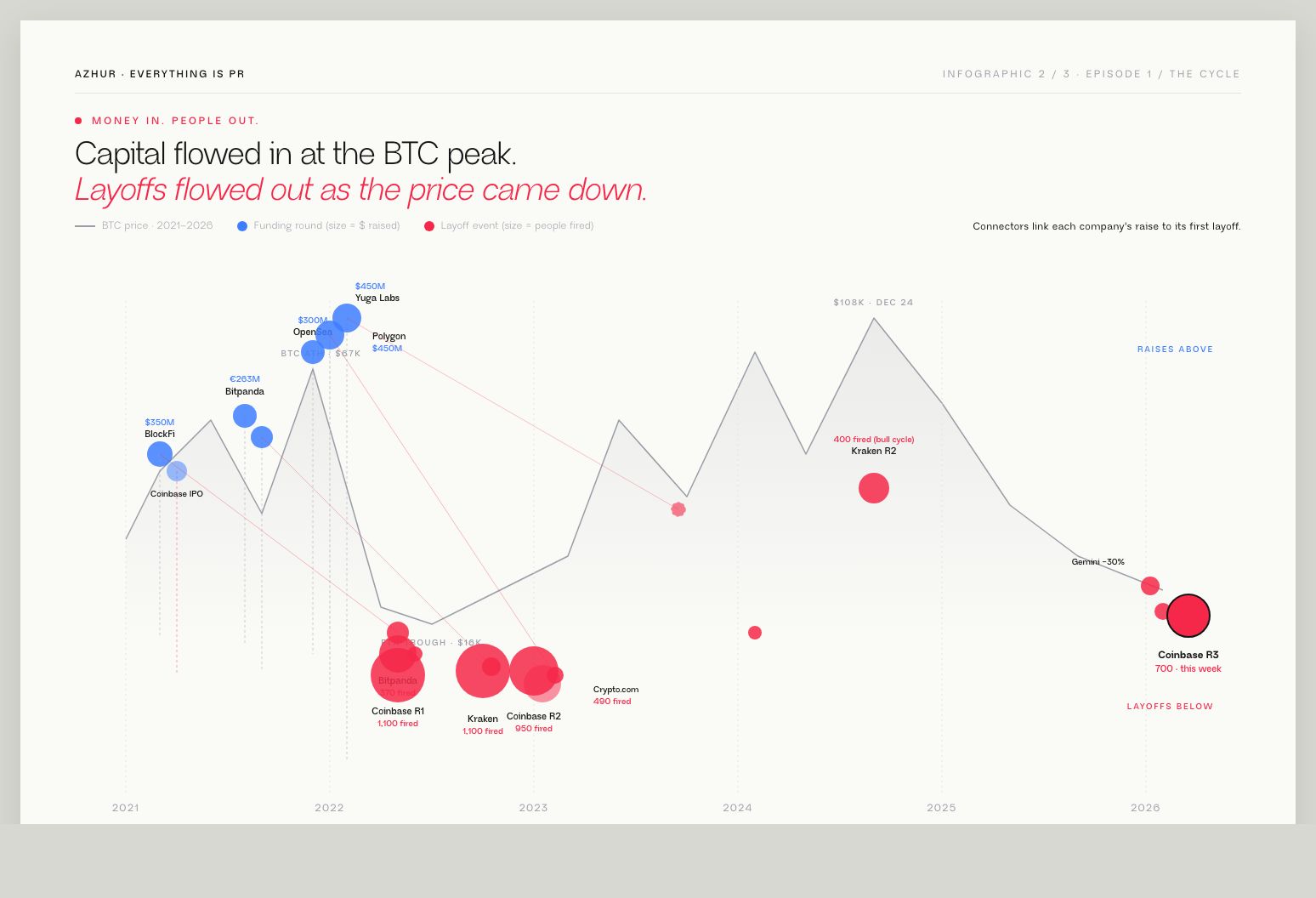
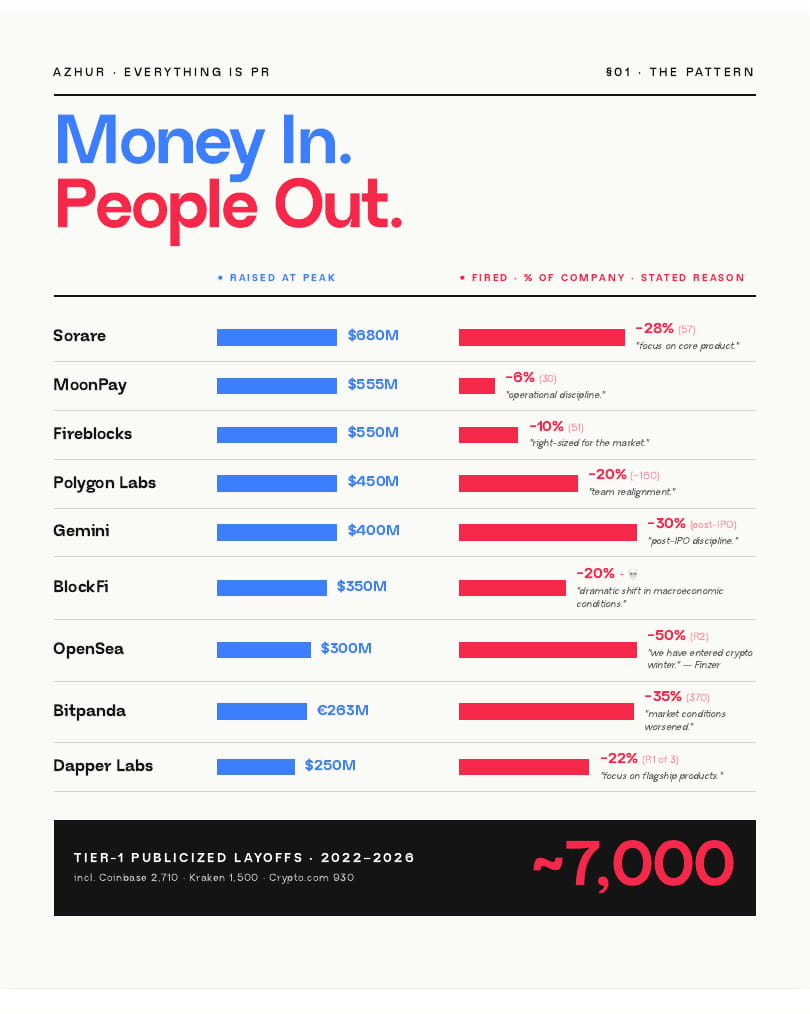
The four largest funding rounds of the 2021–2022 peak — OpenSea at $13.3B, Polygon Labs at $13B, Yuga Labs at $4B, Dapper Labs at $7.6B — all ended in layoffs within eighteen months. The average gap from cheque to cut was twelve months.
VISUAL #2. Money-in vs People-out timeline against BTC curve.
The biggest absolute reduction was Bitpanda: a 35% cut ten months after the raise. The biggest serial offender was Gemini — three layoff rounds in two years, then another 30% within six months of going public in September 2025. Kraken cut ~15% in October 2024 under new co-CEO Arjun Sethi, then hundreds more through 2025 ahead of its IPO listing. Crypto.com's CEO Kris Marszalek repositioned his March 2026 cut as proof he is the AI-pivot leader. BlockFi raised $350M and was bankrupt by November 2022, firing 170 people four months ahead of chapter 11. By March 2023, CoinDesk's tracker had logged 29,868 cumulative crypto-job losses through one wave alone.
This isn't volatility. It is the cycle's operating model.
Crypto sold itself harder than any industry of the last decade on a values frame — community‑first, decentralised, long‑term builders, people first values.
In reality, the practice has been the opposite. Capital raised at peak. Cap tables protected at trough. Teams treated as inventory. The community language was the wrapper; the value flowed upward.
“AI resctucture “ as latest narrative
Each layoff reason — “over‑hired,” “unscrupulous actors,” “reduced demand,” “AI restructure” — does the same job. It externalises a planning failure to a force outside the founder’s control. Macro carries the blame, then “actors,” then technology. The cap table is reset every cycle without admitting strategy collapsed.
It is a narrative control because it is convenient:
cheaper than raising more capital;
less embarrassing than admitting hiring or growth strategy failed;
faster than the slow operational discipline of staffing for cycles instead of peaks.
11 of the 19 companies in this report are headquartered in San Francisco or New York. The cycle pattern — mass cuts announced in a single morning, with same‑day press releases in standardised corporate language — is a US corporate playbook, imported into a globally‑marketed industry.
One counter‑example is worth naming: Yellow Card, the African crypto‑payments company, did not fire anyone during Nigeria’s 2021 crypto ban while every regional competitor did, and went on to raise its Series A. The choice exists. Most of the industry chose differently.
“AI restructure” is not a new strategy. It is the same cap‑table‑protection playbook with a new label. Coinbase told employees to adopt AI tools quickly. When the layoff arrived, the company framed it as “getting AI‑native,” not as “cutting to avoid dilution.” The word “discipline”bridges them: in the old cycle, it masked over‑hiring; in the new cycle, it masks the fact that AI is being used as a layoff narrative, not a real operational standard. Cos how it is to actually integrate AI in processes under HR training initiatives?
“We might want you back later this year”. Seniors are warned sooner.
Press releases are a legal obligation. Trust is supposed to be the byproduct. But these are public companies. In reality, publicly announced layoffs are one‑fifth of estimated crypto jobs lost.
“We might want you back later this year.” That is what a manager said to a friend of mine in crypto last week, the day he was let go. The company is not Coinbase. Senior executives, it seems, are warned earlier: they jump to AI labs in the weeks before the public layoff announcement.
CMO Kate Rouch and five other senior marketing executives left Coinbase for OpenAI in the eighteen months around Round 3. Sarah Wolf, marketing lead for Coinbase’s Base L2 network, left for Anthropic roughly a week before the public Round 3 announcement. The pattern of senior exits just before each round reads like advance notice. The “AI restructure” label coincides with AI labs poaching the senior talent Coinbase claims AI is replacing.
Ex‑Coinbase alumni acknowledge it themselves: the company name on a CV is a recruiter magnet. But that is only true for the named‑company crowd.
Tip of the iceberg
Companies in this report are those that publicized their layoffs through tier‑1 press. The cycle’s quiet operators — firms that cut staff under severance NDAs or below the press‑coverage threshold — are likely running the same pattern, invisible to this sweep. The PR layer is the subject; the silent layer is a different essay.
Not covered: bankruptcies (BlockFi, FTX, Genesis, Voyager, Celsius — different event class), the 2021 China mining ban as a labour‑market story (its own report), the 2025 token‑extinction event of 11.6 million failed crypto tokens (Episode 3), and what functions Coinbase actually cut in May 2026 (they did not disclose).
People dropped from smaller crypto companies — projects that were hacked, rug‑pulled, or abandoned by exiting founders — carry the company name as a stain. The 120,000‑job estimate in this piece comes from aggregating CoinDesk’s tracker, mid‑cap reductions, mining‑ban displacement, and failed‑project fallout — not from a single verifiable database.
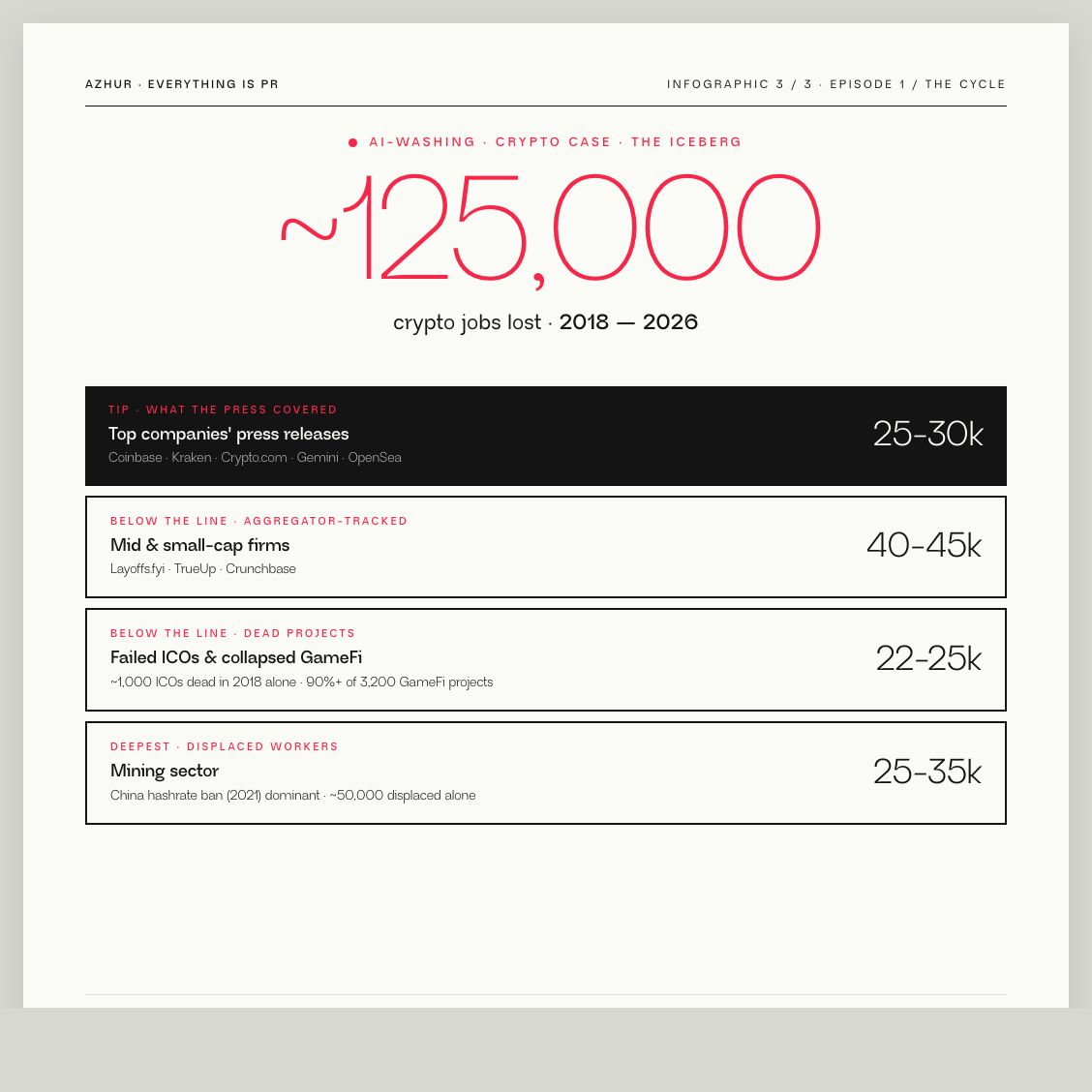
Visual #3. Crypto jobs lost across smaller companies.
The conclusion is simple.
Crypto is a cyclical industry. Nobody serious disputes that.
What is harder to defend is an industry that keeps treating the cycle as unforeseeable after fifteen years of living through it.
That pattern has shaped an entire generation of crypto workers: people hired into euphoric expansion phases, cut during contractions, then told the reset was caused by whatever external force dominated the headlines that quarter.
Macro. Bad actors. Regulation. AI.
The vocabulary changes faster than the operating model.
What to watch. Which post-IPO crypto companies follow Gemini's six-month-post-IPO cut:
Kraken is the immediate candidate, with the S-1 vocabulary already rehearsed in the 2024 and 2025 rounds.
And which label replaces 'AI restructure' once the AI hiring wave breaks. The label changes every 12–18 months. The mechanism underneath has not changed since 2018.
And that may be the real cost of the cycle. Not only the jobs lost, but the gradual collapse of credibility between companies and the people expected to build them.
At some point, “operational discipline” stops sounding temporary.
It starts sounding permanent.
The End of Episode 1 of Everything is PR
News-cycle through the lens of PR expert. Spotting infiltrated narratives. Critical thinking.
———
Azhur is strategic growth consultant based in Paris.
Formerly Sales at Cointelegraph. Founder of ICL Agency since 2018. Background across engineering, government communications, and crypto media.
Writes about media systems, founder narratives, and reputation management across markets.